
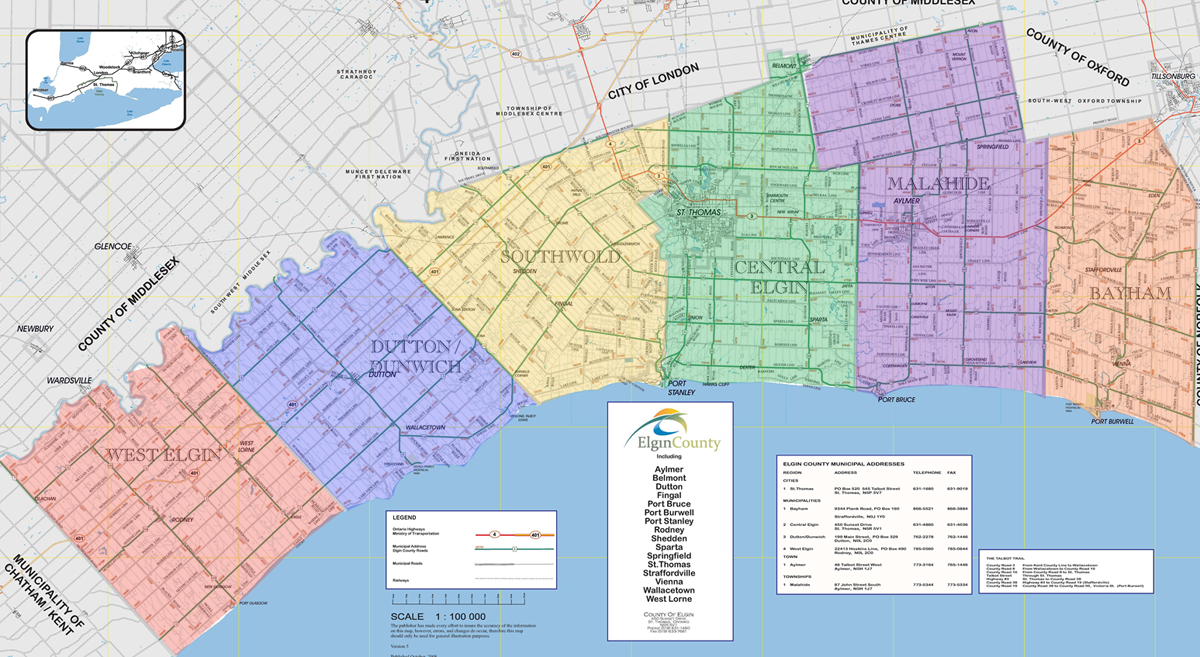
Elgin County
The following history is taken from
Illustrated Historical Atlas of the County of Elgin Ont.
Published by H. R. Page & Co, Toronto, 1877
(Note: A. F Butler was inspector of public schools for Elgin County in the 1870s)
HISTORICAL SKETCH OF THE COUNTY OF ELGIN.
BY A. F. BUTLER, ST. THOMAS.
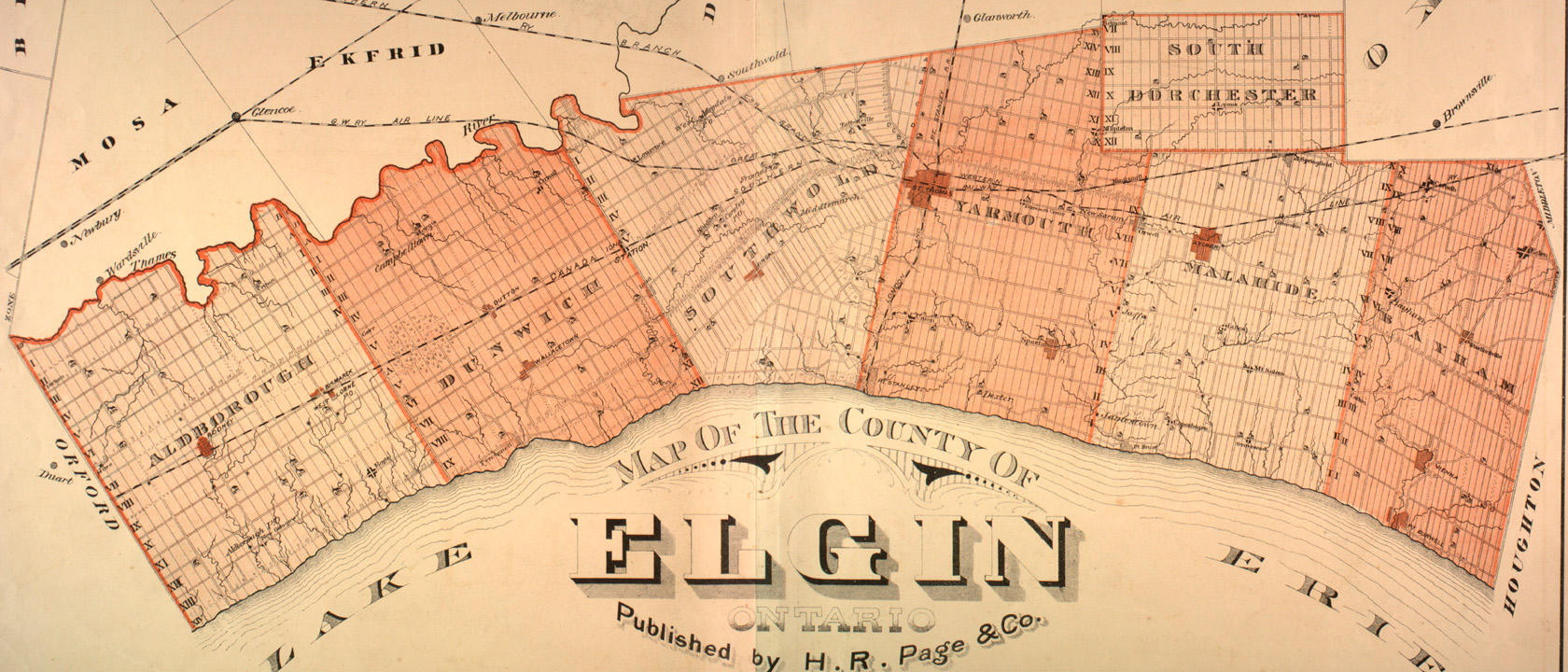
THE territory now known as the County of Elgin comprises eleven municipalities, namely:-the Townships of Aldborough, Dunwich, Southwold, Yarmouth, Malahide, Bayham, and South Dorchester; the incorporated Villages of Vienna, Aylmer, and Port Stanley, and the Town of St. Thomas. It consists of a belt of land on the northern shore of Lake Erie, about 60 miles in length by from 12 to 16 in breadth. It has a history reaching further back than the history of its municipalities, since municipal institutions in Upper Canada (now Ontario) only date from the era of Lord Sydenham, (1841).
Any account of the early settlement of this territory without frequent mention of the name of Colonel Thomas Talbot, would be like the play of Hamlet with Hamlet left out; so from the few writings extant, but more especially from information gathered from incidental conversations with the oldest inhabitants during my official duties of the last ten years, I will endeavor to briefly draw the picture as it was and as it is.
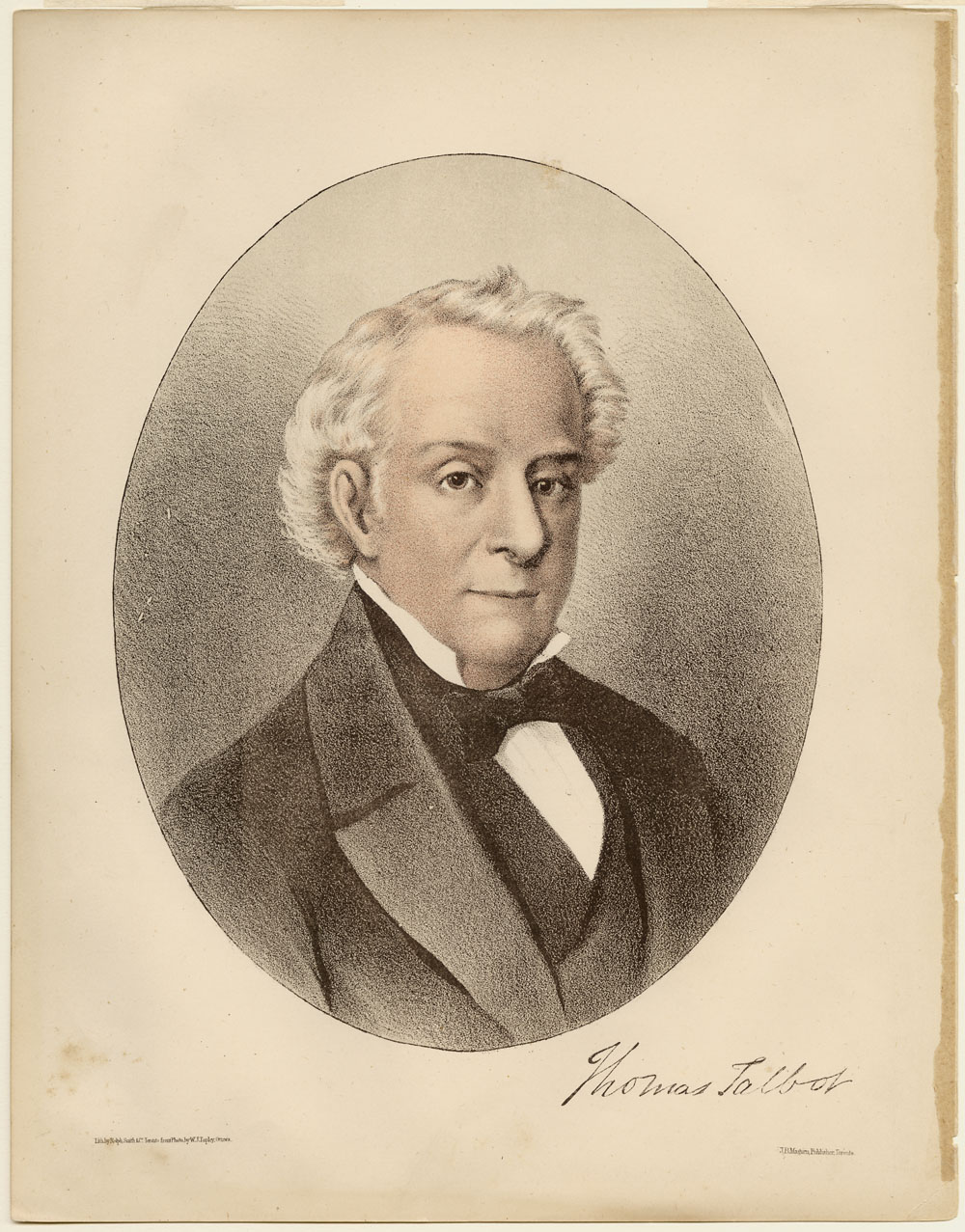
In the latter part of the 18th century (1786-1788) the Lord Lieutenant of Ireland had two youthful Aides de-camp, one of whom was destined to play an important part on the battle fields of Europe, and the other in the settlement of the forests of Western Canada. The first of these was Arthur Wellesly -Lord Wellington- the hero of a hundred fights, who never lost an English gun, and the other was Thomas Talbot, born at the Ancient Baronial Castle of Malahide, in the County of Dublin, Ireland, in the year 1771. In accordance with custom among noblemen's sons in Great Britain, young Talbot was early provided with a Colonel's Commission, was with the 24th Regiment at Quebec in 1790, and in 1791 became attached to the suite of General John Graves Simcoe, the first Lieut.-Governor of Upper Canada. While in this capacity Col. Talbot became acquainted with this fertile and picturesque belt of country along Lake Erie, and, for reasons unknown, decided to leave the comforts of civilization in the old world and plant a new civilization here. Though a noble project, it was certainly, from the standpoint and position of a British officer, an eccentric one, for on the one hand were congenial enjoyments, cultivated society, and prospects of military glory and emoluments, and on the other, for a long time at least, were privations and seclusion in the forests of an unknown land; but the arts of peace, though less dazzling and brilliant than those of war, are intrinsically higher, and while in the one path of life the name of Thomas Talbot might have figured upon the pages of European history, in the other it is spoken and will not be forgotten in the homes and family circles of the Western peninsula of Canada.
Gov. Simcoe seems to have entertained a favorable opinion of young Talbot, and his influence was warmly exerted with Lord Hobart, then Secretary to the Colonies, in a long letter dated 11th February, 1803, recommending the Talbot grants of land. As this letter fully explains the manner in which these grants were applied for and received from the crown, you will read some portion of it with interest here:
SOMERSET STREET, PORTMAN SQUARE,
11th February, 1803.
MY LORD,-Upon my arrival in Canada to carry the constitution which had been granted to that colony into effect, Mr. Talbot accompanied me as my private and confidential Secretary into Upper Canada. He remained in my family four years, when he was called home as Major of the 5th Regiment, then ordered to Flanders. During that period he not only conducted many details and important duties incidental to the original establishment of a Colony to my entire satisfaction, but was employed in the most confidential measures necessary to preserve that country in peace, without violating on the one hand the relations of amity with the United States, and on the other alienating the affections of the Indian nations, at that time with open war with them.
I consider these circumstances, my Lord, as authorizing me in general terms to recommend Mr. Talbot to your consideration and protection. Mr. Talbot's specific application, which I beg leave to support to the utmost of my power, consists of two points. The first is the grant of 5000 acres of land as a field officer, actually and bouafide, meaning to reside in the Province for the purpose of establishing himself therein. The King's bounty having been extended to the field officers who had served during the American war, in grants to a similar extent, it was judged expedient by myself, Mr. Chief Justice Osgoods, and other confidential officers of the Crown in that Colony to extend the provisions to any field officer of character, who, bonafide, should become a settler therein, it being obvious that it was for his Majesty's interest that a loyal set of European gentlemen should as speedily as possibly be obtained to take the lead in the several districts.
In consequence, my Lord, had Mr. Talbot been totally unknown to me, except by his character, and the high rank he had borne in the King's service, "I should have thought him a most eligible acquisition to this Province, "and on this public ground, without hesitation, I have granted him 5000 acres on the same principles that had been laid down and acted upon,-- this is the first part of Mr. Talbot's request. The second request is that these 5000 acres may be granted in the Township of Yarmouth, on Lake Erie, and that the remainder of that Township may be reserved for such a period as may appear advisable to government, for the purpose of his settling it on the following specific plan, namely:-that 200 acres shall be allotted to him for every family he shall establish thereon,--50 acres thereof to be granted to each family in perpetuity, and the remaining 150 acres of each lot to become his property for the expense and trouble of collecting and locating them.His plan is to introduce himself amongst a large body of Welch and Scotch families who arrived at New York in the summer of 1801, and who have temporarily fixed themselves in the interior of that State, many of whom are already disgusted with the dissolute principles of the people there, and feel a strong inclination to return under the government of England, but do not possess the means of purchasing land, or paying the fees demanded by the Province on grants. It remains only for me to add that Mr. Talbot, having been very successful in the cultivation of Hemp, is induced to prefer the distant Township of Yarmouth, as the soil is well adapted to the growth of that valuable commodity. It is his object to extend this cultivation through the whole Township, and by precept and example to enforce principles of loyalty, obedience and industry amongst those with whom he will be surrounded.
I have the honor to be &c.,
J. GRAVES SIMCOE
To the Right Hon'ble,LORD HOBART, &c., &c..
The grants were made in accordance with the request, and such additions were afterwards made to them that they covered in all about 28 Townships with 618,000 acres of land. The rich Township of Yarmouth, however, which the Colonel had thought so well adapted to the growth of hemp was already beyond his reach, the south part of it having been already given or sold for a song, as the common expression has it, to Colonel Baby, and the north to the Canada Company, a wealthy company of English gentlemen who were allowed to purchase hundreds of thousands of acres of fertile lands, as well as some not very fertile, at about one shilling an acre for purposes of speculation.
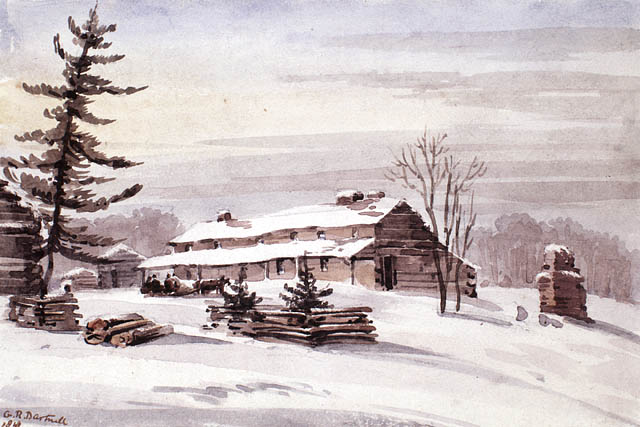
As Colonel Talbot approached his new possessions by water, he selected a spot at the mouth of a romantic winding creek in the Township of Dunwich, as his landing place, naming it Port Talbot. Seizing an axe from an attendant, he at once felled the first tree, animated, we may well imagine, by similar feelings to those of Jacques Cartier, as he placed on Mount Royal the fleur-de-lis and cross, or Columbus, as he kissed the earth of the New World. At this time there was not a human habitation nearer than Long Point, 60 miles eastward. If the felling of this tree be an era in the settlement of the County, let us remember it as occurring on the 21st May, 1803.
The memory of Col. Talbot is certainly entitled to much credit and respect for the founding of the Talbot settlement, at the same time a great many candid right thinking persons have been unable to see why, in placing a settler on 200 acres of land, the division should be 50 to the settler and 150 to Col. Talbot. This was, however, in accordance with the terms made by the Colonel with the British Government, and did not prevent the settlers from acquiring more land by paying for 100 acres the sum of £6 9s. 3d. At this time it was considered an object to get any one to settle upon land in the unbroken wilds of this Western peninsula and the Long Point region, 60 miles east contained the nearest white settlement, and was the chief source of supply for the necessaries of life for some years. It is not necessary, and perhaps would not be becoming, that the writer should here attempt a delineation of the character of the founder of the Talbot settlement. Many anecdotes may yet be listened to, illustrative of his bluntness and his eccentricities, as well as of his firmness, his kindness, his honesty and other sterling virtues. Yes, travel the County of Elgin in the year 1876, and you may be by the hour interestingly entertained on these subjects by the oldest inhabitants, the men who bore the burdens when burdens were not light.
The result with me, although on the whole in the Colonel's favor, recalled the lines of Whittier,-
"Some blamed him, some believed him good,
The truth lay doubtless 'twixt the two."
The progress of settlement for the first few years was slow, George Crane came with Col. Talbot, and in 1809 John Pearce, Col. Leslie Patterson and Mrs. Story with their families located as permanent settlers in Dunwich, west of Port Talbot, and "Johnny Barber built his bark shanty on the lot now occupied by the brick dwelling, and constituting the fine farm of his descendants. In the year 1810 and very soon after came Wm. Davis, David Secord, Benjamin Wilson, Esq., Moses Rice, the Mandevilles, Daniel Rapelje, and a few others.
THE WAR OF 1812
This was an eventful episode in the history of Canada-it added the horrors of war to the privations of pioneer life, and its reminiscences are yet told with much feeling and keen remembrance by the surviving heroes. War is always unfortunate, but in this case was doubly so, because the people of Canada, the real sufferers, were in no sense the aggressors, and indeed had no part in the quarrel which brought about the declaration of war by the United States government. Another fact may also be recorded here, and it is that some of the ablest of the American statesmen of the time opposed with all their power and influence the issue of this declaration.
The Talbot settlement in 1812 numbered three companies of able- bodied men, the only regimental officer being Col. Talbot, who received the commission of Lieut.-Colonel. Two of these companies were termed flank companies, the distinguishing feature of whose service was that they were ready for action at a moment's notice. They were recruited from the unmarried men and widowers without children, and were more perfect in their drill and better equipped than the ordinary militia.
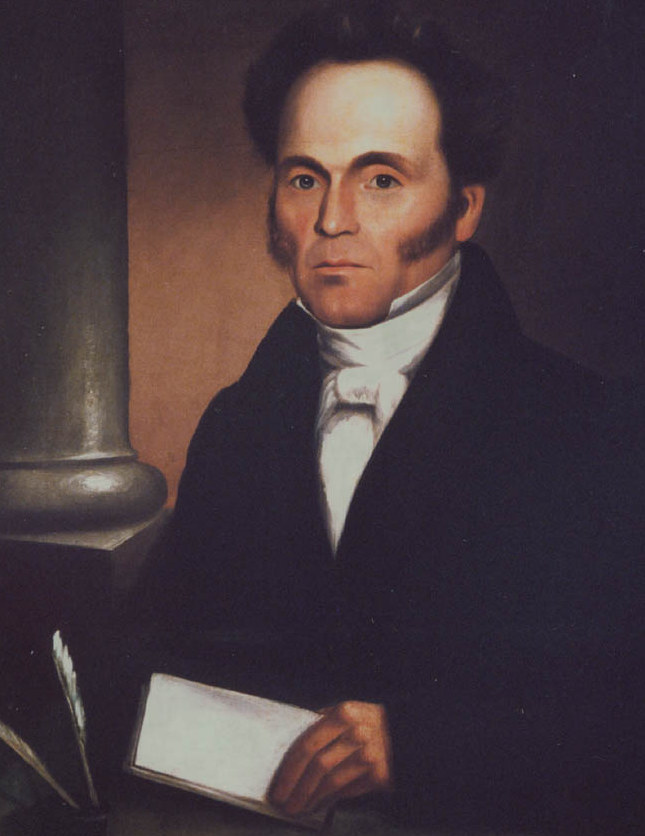
These companies took part in the hard fought engagements of the war, though it happened that these were outside the limits of the settlement. On the 13th of August, 1813, a band of Americans and Indians crossed the forest from the north and burned Col. Burwell's house and Col. Talbot's mill. This mill was of much service to the infant settlement; it was on the winding creek in that romantic valley at Port Talbot, Col. Burwell was confined to his house with fever and ague, but was taken and sent off to Chilicothe and detained several months as a prisoner of war. The party who thus captured Port Talbot, but not the Colonel himself, were from the American army just after the battle of Moravian Town, where the brave Tecumseh was killed, and where General Proctor so disgraced himself by retreating with his army, leaving only one company to face the enemy, who were in consequence made prisoners. At the approach of this party, Capt. Patterson conferred with Col. Talbot, and both agreed that defence was out of the question, and that sauve qui peut was in the emergency, both a duty and a necessity. Accordingly as Commander Walker and his party entered the log mansion on one side, Col. Talbot walked out at another door. An Indian on the outside said to Captain Patterson, "You one officer?" Yes, was the answer. "What officer ?" "Oh! big officer,-Captain." Seeing Col. Talbot walking off, the Indian said, "Who that yonder, he big officer. "No, no," said Patterson," he is only the man that tends the sheep, he is deaf, and would not hear you if you were to speak to him. At the same moment two Indians had levelled their rifles at Col. Talbot, when the other called to them not to fire on the poor man who tends the sheep, and they desisted; the Colonel meantime dropped into the ravine and was out of sight. The premises were completely plundered, and everything of value that was movable was carried off. About two quart pots full of gold, and some silver plate were concealed under the front wing of the house, and thus escaped notice. The horses and cattle were all "confiscated." This style of the general confiscation of effects was not agreeable, and when the family added to that, the prospect of seeing the husband and father, the provider and protector marched off a prisoner, it is not strange that they were sometimes not at home, to such visitors. As Commander Walker and his raiders proceeded westward along the Tyrconnell road, he found no one to receive him, as the families of Messrs. Pearce, Backus, and Mrs. Story, a sister of Mr. Backus, had in the meantime, with the aid of their boat at the lake shore, found a temporary home in a friendly ravine which ran to the beach a short distance away. In their absence, their houses were despoiled of everything that could be utilized; webs of cloth were cut from the looms and carried off, feather beds were ripped open, the feathers scattered, and, the ticks taken away, and cattle and horses were driven away or shot.
In the summer of 1814, a band of mounted desperadoes from Ohio and Michigan, came up the Thames to Westminster, and crossed to Talbot Street, to plunder the settlers in Yarmouth. They pursued the same plan as the others, destroying what they could not carry away. The house of Daniel Rapelje was twice plundered. This house stood on the side hill, between the east side of Kettle Creek, and the present fine residence of John Farley, Esq. A son of Capt. Rapelje had a very nice suit of clothes hanging up in one of the rooms; these were at once confiscated and put on by one of the officers, who also at once put on airs and asked if they did not become him splendidly. "The clothes are well enough, but they are on a very bad man just now," said young Aletta Rapelje. Though cautioned by the older ones of the family, she often made such replies to the plunderers, and her youth and spirit saved her from violence. She is now an old lady living in Norfolk County, and an aunt of Miss Ann Caughell, teacher in S. S. 18, Yarmouth. The arms found in possession of the settlers were destroyed, and as one of the raiders was' breaking the stock of a gun over a log, it accidentally exploded and killed him. This discouraged the others and they departed for Detroit, strewing their path with death and suffering whenever possible. One of their skirmishers was captured by Garret Oakes, Moses Rice, Israel Thayer and William Lee, who in the graphic language of Oakes, at once sent him to inspect the Government Works at Kingston. Garret Smith lived on Lot 1, near what is now Mr. Pincombe's residence, on the banks of the creek north of St. Thomas. To save her effects Mrs. Smith hid some in the standing oats, tumbled others in the well, and Mr. Smith went with his horse to the woods; thus they were saved. John Smith, Esq., for many years Reeve of Southwold, is one of the sons of Garret Smith.
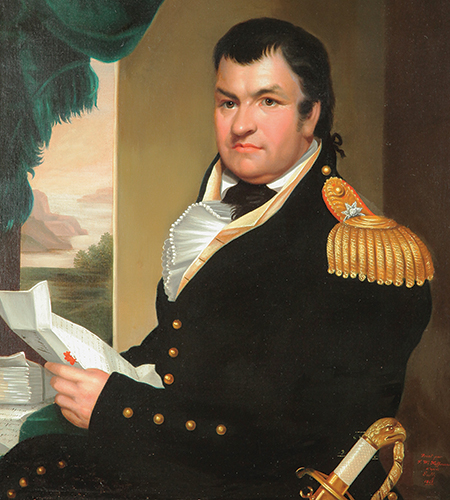
In the fall of 1814, General McArthur started on a plundering expedition from Detroit, through Ontario. As all the able bodied men were on duty on the Niagara frontier, he met with no opposition till he reached the Grand River, where the Indians frightened him, and compelled him to turn southward to Talbot Street, along which he returned to Detroit. What property the previous plunderers had left, McArthur and his thieves managed to find. He camped one night in Yarmouth, and one enterprising boy, maddened at the sight of so many horses being carried out of the country, successfully stampeded seven of them and secured them for himself. The foregoing are some of the incidents occurring in the country during the war. Of course there were alarms innumerable, arising from defective communication among a sparse population. The people were very poor, which no doubt prevented the enemy from visiting it oftener, for the war of 1812, was, on the part of the Americans, a war of plunder. Though they had a force of 180,000 men under arms, they failed to secure a footing in Canada except for short intervals, and then they were invariably defeated and driven out by the militia of the country, aided by the handful of regulars which the mother country was able to spare them in her life and death struggle with Bonaparte. The total number of militia called out and drilled for the defence of the whole country, amounted to about 10,000 men, a force apparently utterly inadequate for its defence, had they not been resolved to sell their liberties as dearly as possible. Of four great expeditions organized for the express purpose of subduing this country, two of them surrendered prisoners of war to a man, and the other two were driven ignominiously from the country, each of them after fighting a pitched battle. We are called upon frequently by the historian, to admire the self-sacrifice and bravery of many nations, in their struggles to retain their institutions and their liberty against overwhelming odds, but we challenge the history of modern times, to surpass the patriotism and devotion of the people of Canada in the war of 1812. To a casual observer the struggle seemed hopeless. Opposed by a population twenty times as numerous, and with resources a hundred fold as great, it would seem that the energy of despair would be required to nerve the people to the conflict. Yet such was not the case. Immediately after the announcement of the war, the first abortive attempt of the enemy was made, and from that time they measured him at his true value, and in many a hard fought field he was taught the lesson that Canadiams were as firmly attached to their principles, and would as readily shed their blood in defence of them as any other people. Among the more noticeable of these old veterans living in the country, we might mention Col. McQueen, who resides near Fingal. At the outbreak of the war he was a boy of nineteen, but the spirit of a soldier was in him, and he was among the first to come forward at the call of General Brock. He volunteered in the Norfolk militia, was appointed ensign, and was immediately along with the Long Point militia sent to Malden in August of 1812. A day or two after, the company to which he belonged was sent across the Detroit river and took part in a skirmish with the enemy in which the latter were defeated and driven into a marsh near the mouth of the Maumee river, where neither they nor their Indian allies could follow them. A few days afterwards he took part in the preparations for the storming of Detroit. He recounts how the commander of the Norfolk volunteers misunderstood the orders, after Hull had surrendered, and instead of helping with his regiment to force a circle around the fort, he marched them in column of subdivision straight through the gate, among the Yankee troops, who were drawn up close under the ramparts inside. They were immediately marched out and the mistake rectified. In the autumn of the same year he was wounded in repulsing the attempted invasion of the Americans at Fort Erie. We have not space to recount all the exploits of this old veteran, but will give a few of the particulars
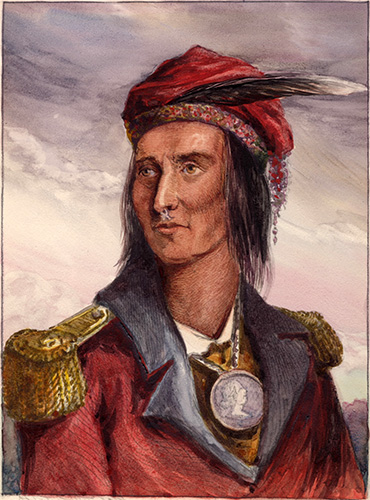
of one which will give our readers an idea of his character and that of the men of Canada in that trying period. About five weeks after the defeat of Proctor and death of Tecumseh at Moravian Town, he was sent by Col. Talbot to bring to Long Point some cattle belonging to the government which had been pastured during the summer at Rond Eau. He had 24 men with him, three of whom were mounted. On arriving at the Fau he found that some American troops from Chatham had been too fast for them, for they had been there and killed them all. He instantly conceived the bold scheme of capturing them, and taking his men into his confidence they agreed to run the risk of the enterprise. A sleigh road led through the wood, and this they followed till they came near the river, where they found a loyal settler who entered into his plans with zeal. This settler had an empty cabin off the road in the woods, and here Ensign McQueen concealed his men for three days, till the watchfulness of the Americans, who had heard of their arrival at the Rond Eau and who expected a visit from him, should abate. On the third night at midnight, his faithful friend brought word that the apprehensions of the enemy had subsided, and without delay he formed his plans and set out on his perilous enterprise. On the spot where Chatham now stands, stood two or three houses, one of which was occupied by a company of regular troops of the United States, numbering 60 men. By using great caution he and his men managed to take them completely by surprise, and made them prisoners of war. The officers he found in an adjacent house and they shared
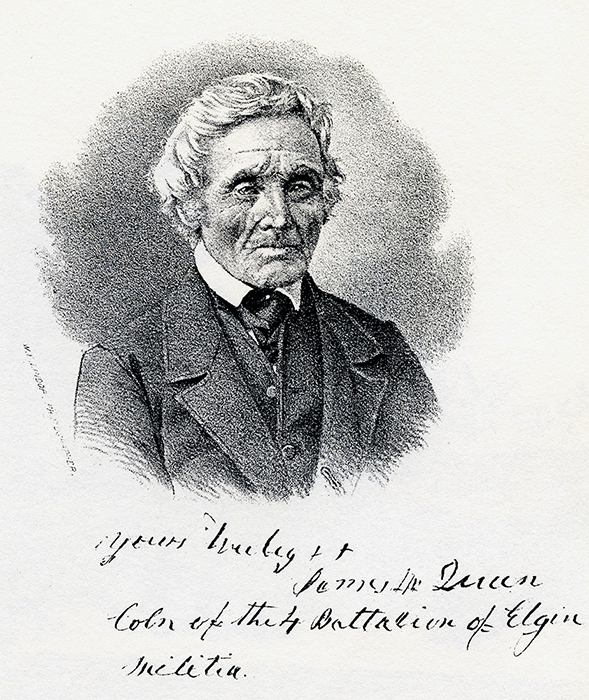
the fate of their men. After disarming them and looking after the wounded, for there was a short struggle in which one of the enemy was killed, and three wounded, he found he had a difficult problem to solve in getting his prisoners to Port Talbot. They outnumbered his men two to one, but he managed the affair satisfactorily, only two escaping from him near where Clearville now stands, while making preparations for camping for the night. He ultimately took them to Burlington Heights where he and his men were highly complimented by General Riall, and given a gratuity of two months' extra pay. The evening before the battle of Lundy's Lane, he was made a captain, and camped on ground where now stands the city of St. Catharines, though not a house graced the site at that time. He commanded a company in the battle which followed, and in a week after he was at his house at Long Point, where his services in the war ended.
At the inception of this work, there were over 40 of the veterans of the war of 1812 living in this county. Their ages ranged from 77 to 105 years. Socrates Hunter who lives at Port Bruce, enjoys the distinction of being the oldest applicant for the bounty of the government among the surviving veterans of the war. He is 105 years old, and was at the battle of Prescott. Several of the applicants are only 77 years of age, and of course were mere boys who were enrolled during the last year of the conflict. Among those who took part in the various battles during the war, and who are still living in the county we mention the following, giving their ages and residence, viz:-
George Yocum, Bayham, 82 years of age, was present at Lundy's Lane and Fort George;
John Thompson Doan, fought at Lundy's Lane, Fort Erie and Black Rock, is 84 years of age and lives in Yarmouth;
Mathias Boughner, lives in Yarmouth, is 77 years of age and fought at Lundy's Lane;
Ransom Dexter, lives in St. Thomas is 83 years old and was present at the battle of Queenston Heights;
Onesimus Bradley, 80 years of age, lives in Malahide, and was at Lundy's Lane;
George Caughell is 81 years old, lives in Yarmouth, was at Niagara and Queenston Heights;
Philo Trood, lives in Southwold, 80 years old, and was at the taking of Ogdensburgh;
Samuel Howie of Bayham, 86 years of age, was present at the burial of Brock;
Matthew House, lives in Malahide, is 82 years old, and fought at Lundy's Lane;
Jean St. Etienne, lives in St. Thomas, is 83 years old, and fought at Chrysler's Farm;
Henry Stringer, fought at Chippewa, lives in St. Thomas, and is 81 years old;
Peter McDonnell, lives in Aldbon, is 81 years old, fought at Chippewa and Lundy's Lane;
Daniel McAfee, is 84 years old, lives in St. Thomas, and was at the capture of Detroit and at the battle of Queenston Heights.
The following are the names, ages, so far as known, and places of residence of the veterans living in the county, who served during the war, but who were not present in any important engagement.
Thomas House, 78 years, of Bayham;
David Kemp, Bayham;
Hugh Sharon, 80 years, Southwold;
Thomas Sharon. 78 years, Southwold;
Jacob Berdan, 83 years, Bayham;
Benjamin Wilson, 80 years, Southwold;
John Conse, 86 years, Yarmouth;
Joseph Vancise, 90 years, Malahide;
Samuel Harper 87 years, Malahide;
Sidney Me Diarmid. 75 years, Bayham;
Thomas Mo Diarmid, 86 years, Bayham;
Robert Eakins, 83 years, Bayham;
Thaddeus Ostrander, 83 years, Malahide;
Horatio Nelson Franklin, 78 years, Malahide;
Thomas Hankinson, 80 years, Malahide;
Francis Richards, 83 years, Malahide;
Peter Smuck, 87 years, Southwold, was present at Queenston Heights;
Ralph Stafford, 83 years, Southwold.
The process of settlement for the first few years was necessarily slow, and fraught with difficulties and serious privations. It is fitting that we should cherish the memories of those old heroes, and heroes they were, for peace has its victories no less than war. In the old church yard of the Episcopal church near Tyrconnell -the Burwell family burial ground near Port Talbot- the cemetery of St. Thomas Church, and at one or two places in the East Riding of Elgin, you may gaze upon the monuments that point out their last resting places -- gray high shouldered stones, moss-covered and marked by the passing years.
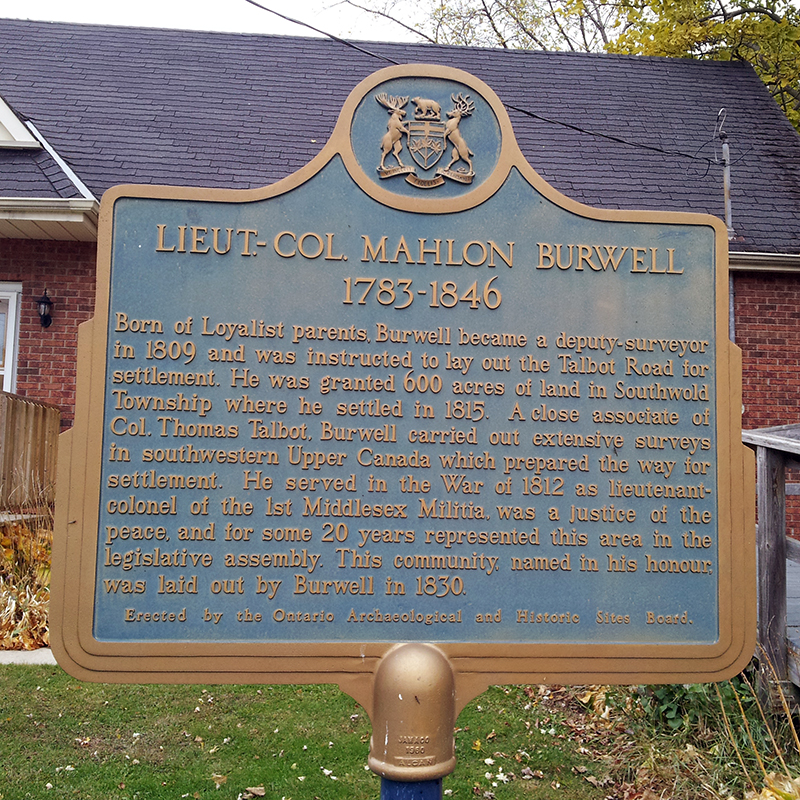
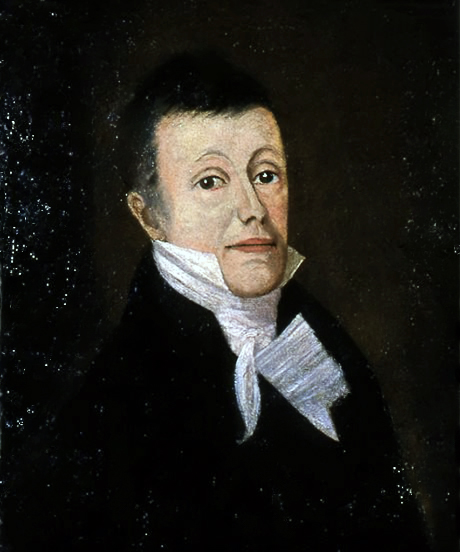
The influence of Colonel Mahlon Burwell extended over the whole settlement now known as Elgin County and indeed over the whole of the London district. He was one of Col. Talbot's first settlers -- was a United Empire Loyalist from New Jersey, and located at Port Talbot in 1809. His first residence was burned at the burning of the mill in 1813. He then built another log house, this time west of Watson's Corners in Southwold, and in 1824 the brick, so cosily embosomed in the little grove of evergreens. This was the old homestead in which he lived until his death; it is now owned by his youngest son, Hannibal, a resident of the city of London.
Col. Burwell's practical knowledge of mathematics rendered him very useful as a surveyor of the unbroken wilds, that have since by the magic wand of labor been converted into fruitful fields. He surveyed the townships of Malahide and Bayham, the city of London, the villages of Port Burwell, Vienna and others. A record of his life would make a readable volume, but a brief notice here is all that allows. Col. Burwell's first election to parliament was for the united counties of Middlesex and Oxford, and the election was held at the log house of David Secord, on Talbot street, in the township of Yarmouth. His course in parliament continued for twenty- four years, a consistent Loyalist to the last. His donations to education and religion were numerous and liberal. The church at Port Burwell, (Rev. J. Schulte, D. D., Ph. D., present rector), was built by him and endowed with 600 acres of land- he was indeed one of the fathers of the settlement, a man of fine and powerful physique, of sterling integrity, and one who lived for the future as well as the present. He left six sons, three of whom, Hannibal, Edward and Leonidas, have made Elgin their home, and are prominent and highly respected citizens among us.
The constitutions as well as the courage of the men of those times were remarkable, and as we meet the remaining ones now, we think of the orator Punshon's quotation as the first line of his "Daniel in Babylon: "There were giants in those days." And such men were needed. A dwarf behind a steam engine may move a mountain, but he who hews it down with his hands is a Titan in strength. There were no roads, no mills, no manufactories, now these are many. The Long Point settlement was 60 miles away, not "lang Scotch miles," but billowy miles on Lake Erie or weary windings along a forest path. But the journeys must be made or families suffer for want of flour and other necessaries of life. Many a time did the pioneers make this journey by canoe or on foot, as attested by Garret Oakes, Meredith Conn, sr., Col. McQueen and others. In 1813, John Rolph located on a lot of land at Catfish Creek; he afterwards moved to Talbot Street, and the low brick cottage in which he lived, a little west of St. Thomas, is still occupied and in a good state of preservation. He was on good terms with Col. Talbot, and in 1817 instituted the Talbot Anniversary, which, on the 21st of May was held in St. Thomas for many succeeding years.
Leaving particulars to find a place in the separate sketches of the municipalities, we come to the time when Upper Canada politics began to engage the attention of the people. Up to the year 1830 the populations of the township could be counted by hundreds and there were no villages except St. Thomas and that numbered but a few families. Then as now there were two political parties, though the positions of the two and the questions that divided them were far from being the same. The writer of these lines is aware that he must either omit an important era altogether or express opinions upon a topic upon which even now opinions differ widely. But the extreme rancour and bitterness of the times have passed away, the right is freely accorded to every Canadian citizen, native or adopted, to speak in sincerity what to him is truth.
It is unnecessary for me to explain now the meaning of the phrase Family Compact." It is well understood, and as you hear it the troublous events and stirring scenes of 1830 to 1840 pass in review before you. The Talbot settlement had its share, for in it there were many strong hearted thoughtful men who must perforce take one side or the other, and taking sides then meant taking action. In parliament it was the old story -- the people against the "divine right" of kings, the democracy against a would-be aristocracy. There may be even now shortsighted persons who would dispose of the whole case by dividing the actors of the time into two classes: loyalists who did their duty, and rebels who sought the destruction of the government. Others more justly speak of the first class as deeming it a conscientious duty to uphold the reigning power, and the second being actuated by unselfish and patriotic motives. but misguided as to the best means to bring about a reform. This is the better sense of to day. and the number is small of those who in the single obnoxious word "traitor" or "rebel” think they tell the whole story of men with hearts and brains like Dr. John Rolph or William Lyon Mackenzie. Mr. Mackenzie often addressed the settlers here at the village of St. Thomas, and some considered it a credit to hold an umbrella to shelter him from the sun as he was speaking, and others to seize the pole of the waggon that formed his temporary rostrum and run it down the hill into
Kettle Creek. Words prepared the way for deeds, and an uprising was determined upon to take place in Toronto 7th December, 1837. Dr. Charles Duncombe was at Oakland with a force largely recruited from Yarmouth, Malahide and other townships ready to join Mackenzie, Lount and Matthews at Little York, (now Toronto), the seat of government for Upper Canada. The impartial facts of that noted struggle have been ably written, (Life and Times of Wm. Lyon Mackenzie and the Rebellion of 1837) and there is not space for them here; besides there are men in Elgin to-day who were in Duncombe's force, and others who were on duty to catch and hang them. William Lyon Mackenzie was an able man – he advocated his cause with an eloquence which only springs from a consciousness of right, and Capt. R. Drake, (father of D. Drake, Esq., present mayor of St. Thomas). though opposed to him in politics, once made this remark: “If they allow that man to speak he will be elected," and this was after he had taken arms against the government, failed, fled from his country, with a price set upon his head, served his time in prison and exile in the United States and returned here ruined in fortune and broken down in health and spirits But it was true and he was elected, although five times before he had been elected and expelled from the House. In taking leave of him I will venture the opinion that his sole motive was the good of others, but the mistake he made was in taking up arms. While remembering with Guizot, that "one right is always left to a people, that should never be relinquished, because its relinquishment is the acceptation of servitude, the sacred right of revolution," he should have trusted to the power of truth and argument, and waited in patient hope for the full day's breaking.
"Knowing this that never yet,
Share of Truth was vainly set,
In the world's wide fallow;
After hands shall sow the seed,
After hands on hill and mead
Reap the harvests yellow."
"For with somewhat of the Seer
Should the moral pioneer
From the Future borrow;
Clothe the waste with dreams of grain,
And on midnight's sky of pain,
Paint the golden morrow."
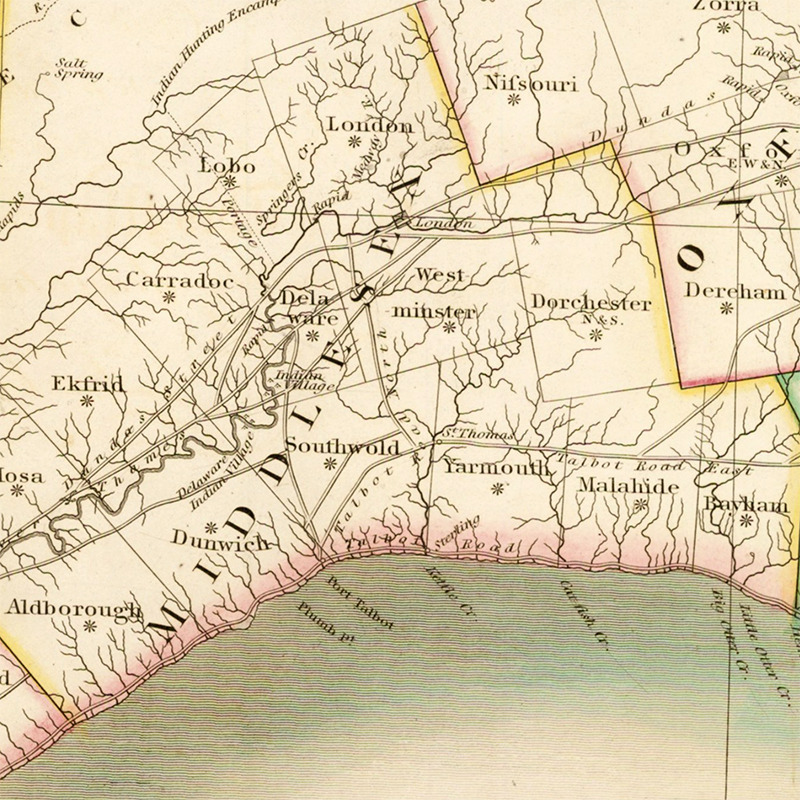
In 1792 the Province was also divided by Governor Simcoe into nineteen counties, of which Middlesex was one, with Lake Erie for its southern boundary The townships received their names when they were surveyed, but there was no municipal organizations of any kind until its introduction by Lord Sydenham in 1841. After this time the growth and development of our belt of territory was more rapid, and its history emerges from that of a pioneer settlement to that of an enlightened and prosperous community. A reference to reliable statistics is often useful as a retrospect of the past and a source of encouragement for the future. The following table shows the population of the different townships at different periods taken from census reports, the last from the Dominion census of 1871:
| POPULATION IN | 1817 | 1848 | 1852 | 1861 | 1871 |
| Aldborough | -- | -- | 1,226 | 2,325 | 3,506 |
| Dunwich | -- | 652 | 1,948 | 2,888 | 3,731 |
| Southwold | 900 | 4,443 | 5,063 | 5,467 | 5,559 |
| Yarmouth | 400 | 5,748 | 5,388 | 6,166 | 5,563 |
| Malahide | 775 | 4,043 | 4,050 | 5,320 | 5,564 |
| South Dorchester | -- | 1,587 | 1,650 | 2,204 | 2,071 |
| Bayham | -- | 4,030 | 5,092 | 5,151 | 4,892 |
| Vienna | -- | -- | -- | 908 | 593 |
| St. Thomas | -- | -- | 1,274 | 1,621 | 2,197 |
| Total | -- | 22,491 | 25,418 | 32,050 | 33,666 |
The column for the year 1817 is not added, as it is incomplete. South Dorchester, in 1817, was an unbroken wilderness, Vienna and St. Thomas were parts of Bayham and Yarmouth, and Dunwich and Aldborough, as late as the year 1836, contained, the first 616 and the second 592 inhabitants. The increase on the whole from 1848 to 1871 is about 50 per cent., a remarkable increase truly, showing the adaptation of the territory for the maintenance of a large, active and industrious population. The County of Elgin had its first existence as a county in 1852. Previous to this, its territory was a part of the County of Middlesex, and it was finally thought that the officials and inhabitants of the Town of London exhibited a desire to not only incur heavy liabilities for the improvement of that immediate vicinity, but to get the lion's share of the profits generally.
MUNICIPAL ORGANIZATION
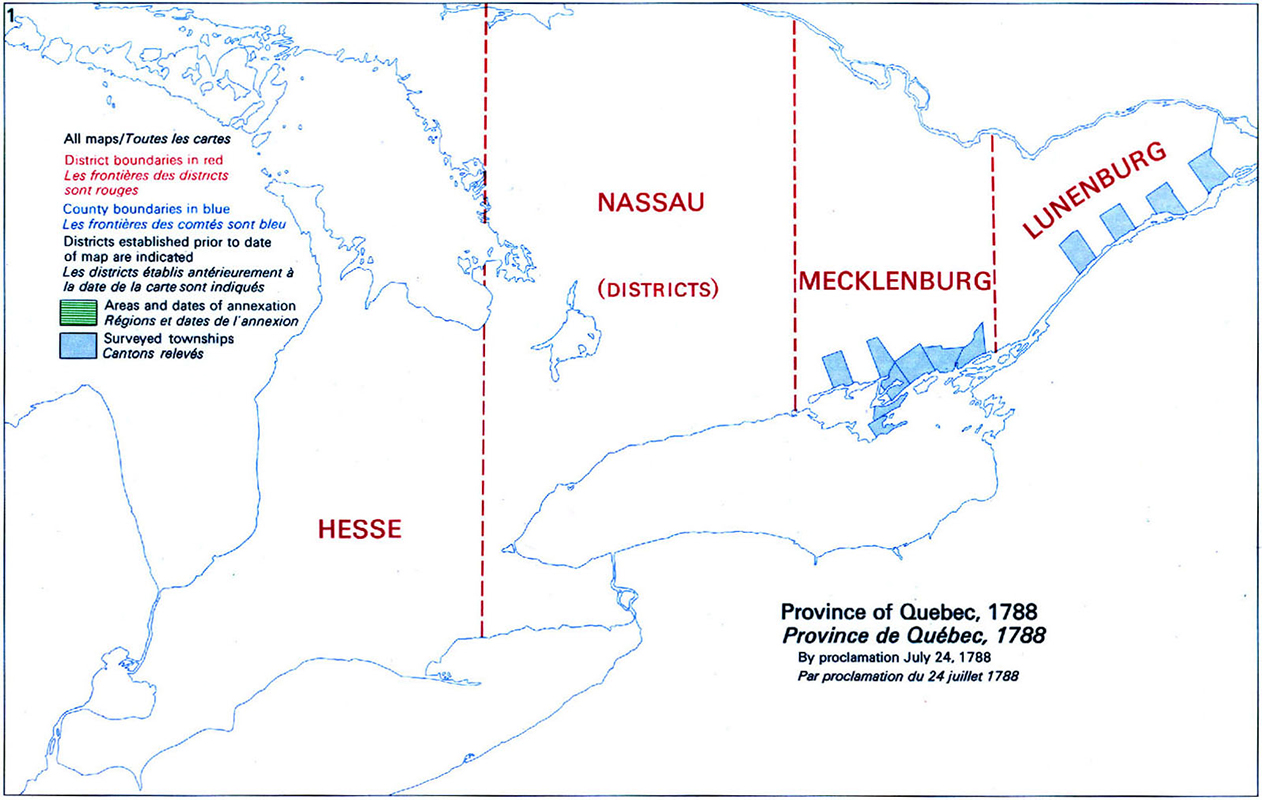
The first territorial division of what is now the Province of Ontario was made by Lord Dorchester in 1788 by Proclamation under the authority of a British Act of Parliament. By this division it was divided into four districts, namely:-Lunenburgh. Mechlinburgn, Nassau and Hesse. The Provincial Act, Geo. III., 1792, continued these four divisions, but called them Eastern, Midland, Home and Western. Each District was to have a gaol and court house. The Western District comprised this whole western peninsula from Lake Erie to our northern boundary and it was once ordered that the gaol and court house should be at Detroit, and soon after at Michilimackinac (Mackinaw, on Strait of Mackinaw).
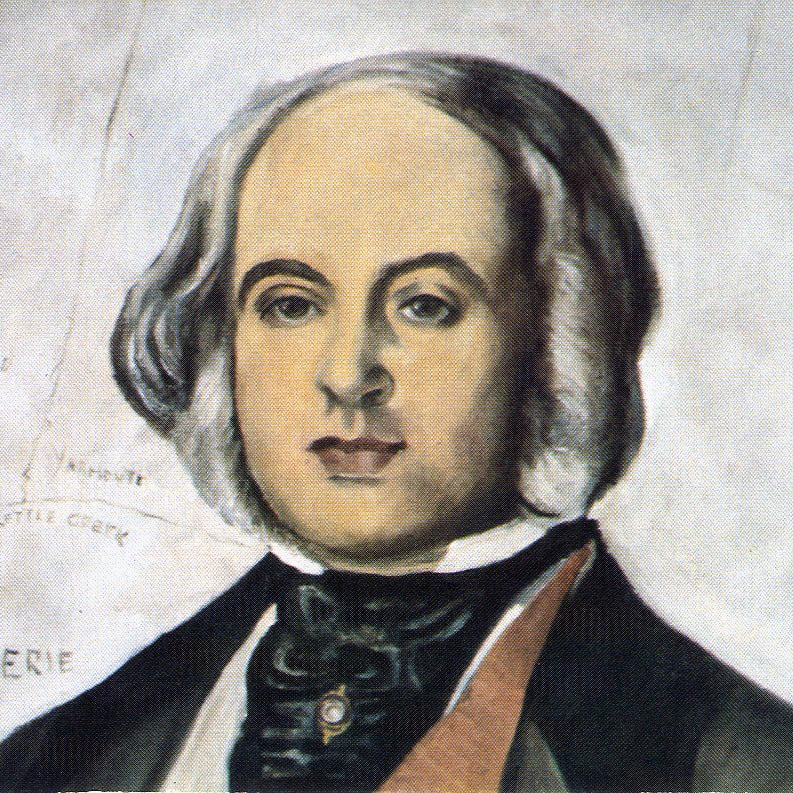
In 1850 an agitation was commenced in which the leading citizens of Thomas and the lake shore townships took a prominent part, and a new county was created for judicial purposes, under the authority of the Territorial Division Act of 1851. This county was named Elgin, in honor of the Earl of Elgin, Governor-General of Canada, from 1847 to 1854, and who so nobly aided the cause of education during his administration. Lord Elgin was a leader of whom any country might well feel proud. His magnanimity and firmness won the highest respect of his people, while his graceful eloquence lent its force to the promotion of every good work. This was a golden era for the province, and the county of Elgin shared in the general prosperity.
The first provisional Council met in the Town Hall, St Thomas, on the 15th day of April, 1852, and was composed as follows:
Duncan McColl, Reeve, Aldborough.
Moses Willey, Reeve, Dunwich.
Colin Munro, Reeve, Southwold.
Nicol McColl, Deputy Reeve, Southwold.
Elisha S. Ganson. Reeve, Yarmouth.
Leslie Pearce, Deputy Reeve, Yarmouth.
David Parish, Reeve, St. Thomas.
Thomas Locker, Reeve, Malahide.
Lewis J. Clarke, Deputy Reeve, Malahide.
Jacob Cline, Reeve, South Dorchester.
John Elliott, Reeve, Bayham.
J. Skinner, Deputy Reeve, Bayham.
Elisha S. Ganson, (now one of the money lords of Woodland Avenue, Cleveland), was chosen Warden, but resigned on the 22nd July following, on account of differences between himself and the members on the subject of expenditure in erecting the county buildings. Levi. J. Locker of Malahide was appointed to fill his place. Mr. Locker presided over the Council ably and faithfully for the remainder of the year and for the next three succeeding years, when he retired from municipal labor.
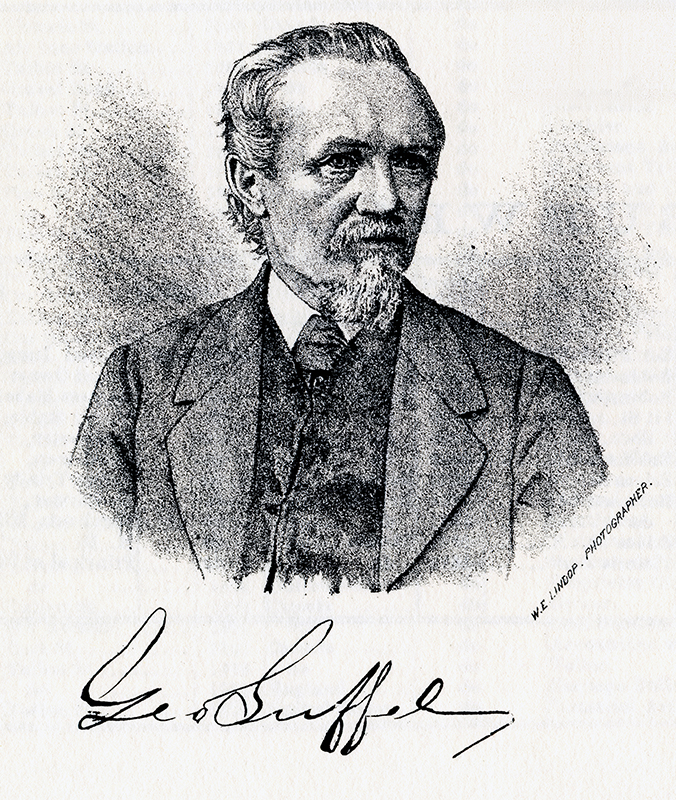
The honors of the Wardenship have been, since the appointment. of Mr. Ganson, as follows: 1853-1855, Thomas Locker; 1856- 1857, Randolph Johnson; 1858-1859, Levi Fowler; 1860, James Armstrong; 1861-1862, J. H. Jones; 1863, Daniel Luton; 1864, George Suffel; 1865, John Clunas; 1866-1871, T. M. Nairn; 1872, John Ellison; 1873-1874, John McCausland; 1875-1876, George Suffel.
John McKay was the first County Clerk. In 1853 he resigned this position to receive the Governmental appointment of County Registrar. He held this position until his death, July, 1876. The present incumbent is Archibald McLachlin, Esq, the founder and for many years, editor and proprietor of the Home Journal. William McKay received the appointment of County Clerk in 1853, and has continued to discharge the duties of the office until the present time with diligence and fidelity mingled with courtesy to all.
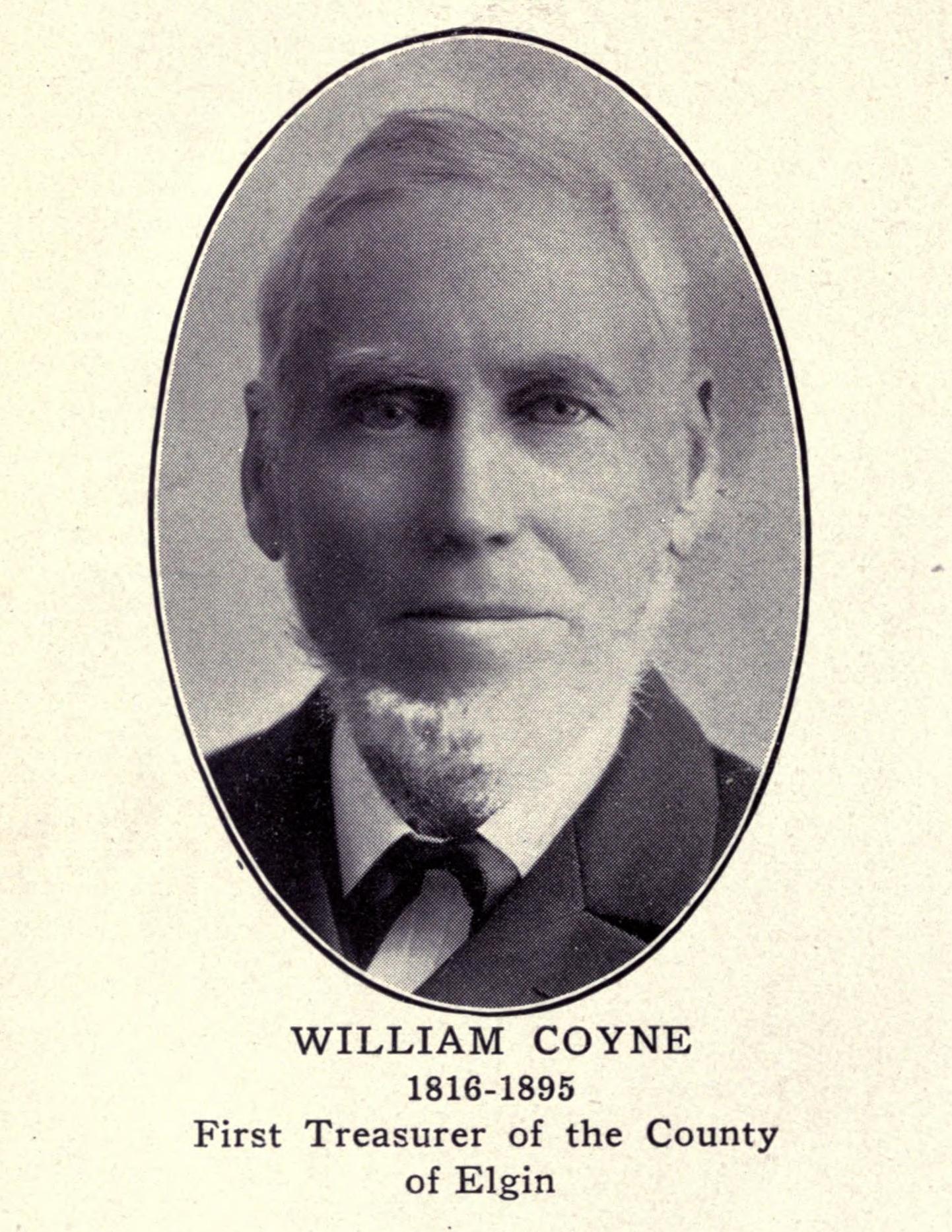
Wm. Coyne was County Treasurer for the remainder of 1852. He was succeded by Henry Black, who held the position until 1858, when he came to grief as a defaulter to the extent of about $12,000. George T. Claris Esq., then received the appointment to the duties of this important and responsible office. Mr. Claris brought to the work remarkable financial skill and ability; sterling honesty that no temptation could approach, and that uniform kindness and courtesy which won the respect and esteem of all with whom he came in contact. Although a gentleman of means and not at all dependant upon his salary as Treasurer, he gave his best efforts even during extra hours, to the financial interests of the county. On the death of Mr. Claris in the spring of 1875, Mr. John A. Kains was chosen, who has since discharged the duties of the office to the entire satisfaction of the Council. The executive officers of the county at present, (Oct. 1876), are D. J. Hughes, Esq., Judge of the County Court and of the Surrogate Court of the County of Elgin, and Chairman of the Quarter Sessions, &c., &c., appointed by Government. Colin Munroe, Esq, Sheriff, appointed by Government. Geo. Scarff, Deputy, appointed by the Sheriff. Archibald McLachlin, Esq., Registrar, appointed by Government. Charles Askew, Esq, appointed by the County Judge, T. D. Warren, Esq, Clerk of the County Court, of the Surrogate Court and Deputy Clerk of the Crown; appointed by the Dominion Government. Charles G. Rich, Feq, gaoler, appointed by the Sheriff. Wm. McKay, Esq., County Clerk, appointed by County Council. John A Kains, Esq., Treasurer, appointed by County Council. A. F. Butler, Esq, Inspector of Public Schools; appointed by County Council with sanction of Education Department Judge Hughes and Sheriff Munro were appointed when the County was established.
The present County Council is composed as follows:
George Suffel, Warden.
John McKillop, Reeve of Aldborough.
Peter Stalker, 1st Deputy of Aldborough
T. W. Kirkpatrick, 2nd Deputy of Aldborough
John Galbraith, Reeve of Dunwich.
John Lyons, Deputy Reeve of Dunwich
Dugald Brown, Reeve of Southwold.
Ewin Cameron, 1st Deputy of Southwold
William Risdon, 2nd Deputy of Southwold
Samuel Day, Reeve of Yarmouth.
James Martin, 1st Deputy of Yarmouth
Israel Marlatt, 2nd Deputy of Yarmouth
David F. Davis, Reeve of Malahide.
Wesley McCausland, 1st Deputy of Malahide
Ambrose Hill, 2nd Deputy of Malahide
T. W. Dobbie, Reeve of Bayham.
Henry Stratton, 1st Deputy of Bayham
William Backhouse, 2nd Deputy of Bayham
William H. Brown, Reeve of South Dorchester.
Edward Ilegler, Deputy Reeve of South Dorchester
John Ellison, Reeve of Port Stanley
T. M. Nairn, Reeve of Aylmer
The progress of the County must continue to be an interesting subject, not only to those who may claim it as their birth place, but to all who find in it a home. This progress is exhibited most clearly by facts and statistical tables which are introduced here for future reference and for a few words of explanatory comment. We have seen that the population increased from twenty-two thousand in 1848 to thirty-three thousand in 1871. This increase has not been as rapid for a few years past, nor will it probably be for years to come, as Elgin is peopled by an agricultural community, and the lands now nearly all settled upon. An accurate census at present would give about 33,000. The social and financial condition of a people however is of more importance than mere numbers.
Total value of real and personal property in the different municipalities in the County of Elgin from the Assessors' rolls and Council Equalization Reports for the following years:
| No. of acres assess'd | Assessed 1862 | Equalized 1867 | Equalized 1870 | Equalized 1873 | Assessed 1875 | |
| Aldborough | 78,000 | $403,335 | $700,305 | $971,663 | $888,912 | $903,502 |
| Dunwich | 70,000 | $469,482 | $947,506 | $1,113,255 | $1,135,420 | $1,855,665 |
| Southwold | 68,800 | $978,100 | $1,416,540 | $1,596,281 | $1,685,936 | $2,956,320 |
| Yarmouth | 71,000 | $1,054,356 | $1,633,423 | $1,957,478 | $1,775,637 | $2,792,517 |
| Malahide | 59,400 | $735,593 | $1,267,755 | $1,281,666 | $1,332,182 | $1,992,795 |
| South Dorchester | 43,200 | $301,640 | $638,000 | $647,250 | $733,200 | $1,006,205 |
| Bayham | 60,000 | $601,782 | $794,388 | $871,402 | $719,705 | $1,506,866 |
| Vienna | -- | $85,616 | $90,650 | $70,000 | $60,000 | $92,623 |
| St. Thomas | -- | -- | -- | -- | -- | -- |
| Aylmer | -- | -- | -- | -- | $85,000 | $375,347 |
| Port Stanley | -- | -- | -- | -- | -- | $110,295 |
This table gives a view of the relative growth and progress of the county, but is by no means an accurate estimate of the real value in dollars and cents of all the property within its borders. While the increase has been from five to fifteen millions in thirteen years, as per assessors' rolls, it is not an over estimate to say that the actual value is not less than thirty millions of dollars.
ROADS AND MEANS OF TRANSIT
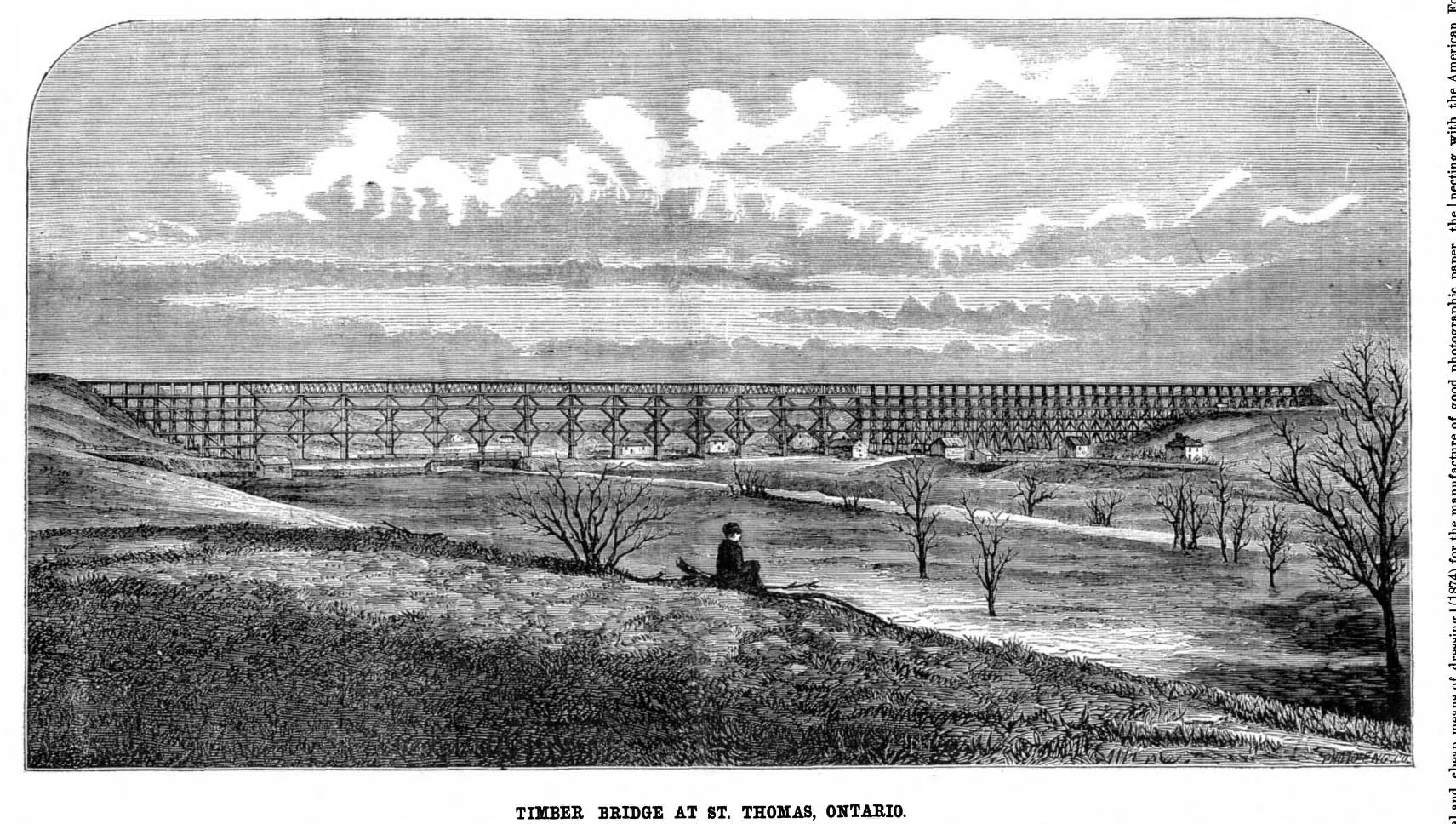
Garret Oakes, Esq., the entertaining writer of " Pioneer Sketches," tells of his trials in getting a small grist of corn to Long Point and back again, and the remembrance is yet very clear in the minds of other veterans, of Indian trails, miry paths, blazes and corduroys; but the present presents a different picture. Besides the many excellent highways, made excellent by statute labor, there are four gravel roads owned by private corporations, and four railroads. The London & Port Stanley Railroad, running from London to Port Stanley through the Town of St. Thomas, was opened in 1857. It was never a great road but often a great convenience. It was built mainly by the Counties of Middlesex and Elgin, and is now leased to the Great Western Company for a period of twenty years. During the dull times that followed the financial crisis of 1857-8, traffic was not brisk; and the first ride over the road, enjoyed by the writer, was one, when he had no difficulty in getting a seat, as the only passengers besides himself were Samuel Price, Esq., of Port Stanley, and H. C. R. Becher, Esq., of London. There are now six trains per day, and during the summer season the passenger traffic (chiefly excursion parties to the picnic grounds on Port Stanley Heights) is very considerable. In the year 1871 were opened the Canada Air Line and the Canada Southern Railways. The Air Line is a branch of the Great Western from Glencoe, in the County of Middlesex, to Buffalo, U. S. This road does not traverse the entire length of the County, but enters it on Lot 8, Routh's Survey, in the Township of Southwold. The River Thames is spanned at this point by a handsome timber bridge 820 feet in length, consisting of three spans of Burr truss, each 100 feet, (over the bed of the river,) and about 260 feet of trestle work on each side. It is about seventy-two feet high, contains about 600,000 feet of (B. M.) timber, and cost about $25,000. The road passes through St. Thomas, crossing Kettle Creek over a similar bridge-through Yarmouth, Malahide, the thriving village of Aylmer, through the north part of Bayham, and thus out of the County. It is a good road, well furnished and managed, and does a large passenger and freight business.
The Canada Southern Railway, completed in 1872, traverses nearly the entire length of the county east and west, passing through every township except Bayham. It is claimed for this road, and with very good show of reason, that its grades are lighter, its line more direct and with less curves, and its equipment better than those of any road in the Dominion. Express trains have been run on this as well as upon the Air Line, during the season of 1876, at the rate of 50 miles per hour including stoppages. From Amherstburgh, on the Detroit River, across this Western peninsula, through forest and fertile field, over chasm and flowing stream, this road is nearly a direct line. The stations in the county commencing at the west are: Taylor, Rodney, Bismarck, Dutton, St. Thomas, Kingsmill, and Springfield. The journey is a delightful one and the passenger coaches are rolling palaces. The earnings of the Southern for the third week of August, 1876, were: Passengers, $14,471.25; Freight, $20,706.30; Mails, Express, &c., $811.72; total, $35,989.17. For the corresponding week of last year the earnings were $26,722.06; an increase of over 30 per cent. All things considered, no county in Canada is more favorably situated for road and railway facilities. But these advantages were not a free gift, nor did they, like Jonah's gourd, spring up in a night. The press and the people of the county put forth every exertion, and spared neither argument, labor nor money. The county aid to the London and Port Stanley road was in the shape of stock, and though the road was an advantage, the stock was not, and it proved a small elephant, bought for $80,000 and sold in 1872 for $5,000. It is not necessary to explain how $80,000 could be reduced to $5,000. The solution of that problem is easy when the peculiar relations existing between the following factors are well understood, viz: First mortgage bonds against stock; running expenses and interest on borrowed money against earnings. The county also aided the Canada Southern by a bonus of $200,000. The by-law warranting this was submitted to a vote of the people on the second day of August, 1870. Railroads are promoters of civilization as well as commerce, and their benefits will endure after all bonus debentures have been paid and wiped out.
EDUCATION
School privileges were few and meagre for the early settlers. In 1816 a school was established in Malahide, the first in the county; in 1818, one in Col. Burwell's neighborhood, now Watson's Corners, in Southwold; in 1820, one in Bayham; in 1821, one in Aldborough and another in Bayham; in 1822, two more in Southwold and one more in Aldborough; in 1823, one in Dunwich; in 1827, two in Yarmouth, and up to the year 1830 only twenty schools existed in the whole county. In the last mentioned year, Mr. Alexander Weldon, (a teacher in the county from 1833 until 1857), attended as a pupil in a log schoool-house at Watson's Corners, Talbot Street, Southwold. The sons of Colonel Mahlon Burwell were also pupils. A huge open fireplace occupied one end of the room. The furniture was rather primitive, the seats made of slabs split from basswood logs, smoothed a little with an axe. The portraits of the teachers of those times as drawn by those who then pursued knowledge under difficulties, are quite in keeping with the school houses. Mr. Weldon was desirous of studying grammar, and as "love" is the word with which young people begin, he asked the teacher if it was a verb. Teacher replied, "he guessed it was." Mr. Weldon had to conclude that whatever luck the teacher might have in "guessing” on "love," he really knew nothing about grammar. He had better advantages in teaching arithmetic as he had two ways of deciding whether a question was solved correctly: one was to resort to a key, and when this was not at hand to "guess" at it. As far as the benefits to the pupils are concerned, these two methods should be considered equally satisfactory. Certificates were not in fashion then, and visions of county boards of examiners troubled not the dreams of pedagogues.
To exhibit the growth of our educational machinery since then it will be sufficient to take a few periods a number of years apart, -- without studying its development -- for each successive year. In 1847 the total amount expended for school purposes was, Aldborough Total $11,128.00. $500.00, Dunwich $656.00, Southwold $2248.00, Yarmouth $3600, Malahide $2240.00, Bayham $1864.00. We have no classification of the school houses, but as late as 1852 there were two brick, 73 frame, and 22 log-total, 97.
A tabular view gives the most information in the least space:
| Year | Amount paid Teachers | Building and Repairs | Total for School Purposes |
| 1847 | -- | -- | $11,128 |
| 1852 | $13,532 | $3,800 | $20,756 |
| 1855 | $21,184 | $8,692 | $31,524 |
| 1861 | $22,277 | $6,704 | $26,823 |
| 1868 | $26,825 | $4,967 | $34,397 |
| 1872 | $27,527 | $10,162 | $41,821 |
| 1876 | $38,762 | $16,177 | $64,287 |
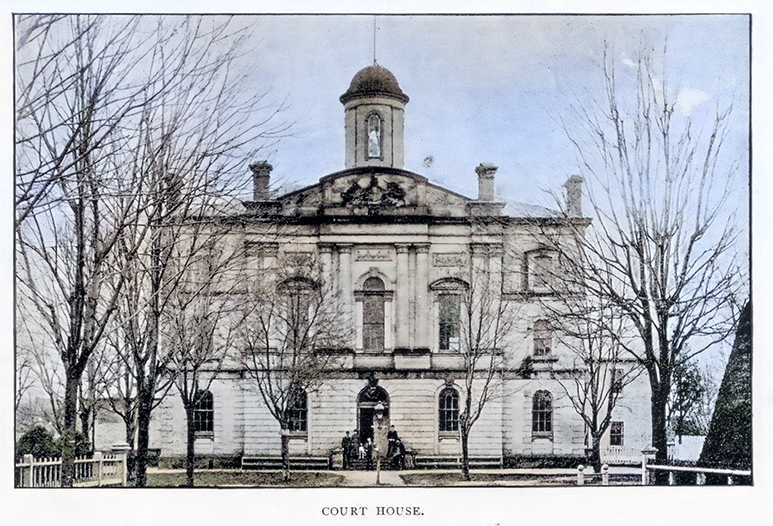
The above figures are very significant, and to those interested in the welfare of this particular portion of “this Canada of ours," very encouraging. The decrease from 1855 to 1861 is owing to the Russian war and inflations of currency, and the depression that followed the financial crisis of 1858. The classification of school houses gives 70 frame, 33 brick-log, none. Sixty new school houses have been built since the passing of the School Law Improvement Act of 1871; indeed the transformations by the weird wands of fairies and conjurers, to be read of in wonder book, for the children, are no more complete and much less gratifying than those wrought in school accommodation under the operations of this law, by the liberality of the people. The average of the salaries of male teachers in 1852 was £60-$240, and in 1876 over $400 per annum. Salaries at present are not at all commensurate with the true dignity and importance of the teachers' profession, but such is the excellence of our educational system, and the scholarly ambition of our young people, that teachers are many, and the consequent competition for places prevents a higher remuneration. In the latter part of the year 1865, Rev. Egerton Ryerson, then and for many years Chief Superintendent of Education, in making a tour of the Province, held a convention in the Court House, in St. Thomas, for the purpose of conferring with the people upon proposed school legislation. His views upon some points were strenuously opposed by some of our local leaders, who, by the way, were not a match for the Chief on his favorite topics, his final reply being a specimen of eloquence. graceful, earnest and convincing. The main features of the Act of 1871 were afterwards submitted by him and fully approved at a similar convention largely attended by leading men and educators from all parts of the county, held in the Court House, in St. Thomas, February 19th, 1869. I will close this brief summary by recording the fact, that this year of hot summer weather, 1876, witnesses the many flattering and favorable notices from the American press, and from distinguished foreign educators, concerning the educational exhibit of Ontario at the Great Centennial or World's Fair in Philadelphia.
HOMES AND HOME SURROUNDINGS
This is a topic the value of which cannot be correctly estimated in bushels, pounds or dollars. In the early times the settlers had to be satisfied with the cabin in the wilderness, or the log hut in the clearing. Contentment and true happiness, however, were perhaps as often found as in the brown stone mansion of Euclid Street or Fifth Avenue; and these words of Mrs. Moodie in the Third National Reader were often realized if not uttered: "Our hut is small and rude our cheer, But love has spread the banquet here." Elgin has now its town, village and country homes, where taste, skill and wealth have combined to make attractive the resting place to which the weary return as doves to their nests. In many a noble farm house now may be found books, pictures, musical instruments and furniture of luxurious and costly design. There literature offers its winning and lasting solace from care; art pleases the eye and refines the taste, and music with its silver sound exerts an ever potent charm.
Elgin County Library
| Church History Elgin Presbytery London Conference –The United Church of Canada 1967 | Included in this booklet are 50 locations/towns in Elgin highlighting the churches with a write up of each one. |
| 60: 1917-1977- Elgin County Holstein Club | Contains a history of the Elgin County Holstein Club. |
| A Check List of the Butterflies of Elgin County, Ontario | A checklist of butterflies found in Elgin County from 1910 to 1985. |
| A Condensed History of the Court House (courthouse) Cannons ( Elgin County) | A short history of the Elgin County Courthouse Cannons. |
| A Pioneer History: Elgin County | A collection of award wining school essays on Elgin County School Sections and Townships written as part of a contest sponsored by the Southern Counties Journal and the Elgin Historical And Scientific Institute in 1896. Contains lots of great early history on the County Of Elgin. |
| Agricultural Analysis of Elgin County |
|
| An Agricultural Survey Of Elgin County | Fourth-Year Thesis by G.N. Procunier. Ontario Agricultural College, 1944. |
| Annals of Northern Bayham: Gilbert Anger's Journal, 1901-1904 | The daily journal of Gilbert Anger, a Bayham Township farmer, from March 27, 1901 to April 14, 1912. |
| Baptist Churches Elgin County | Includes Elgin association of Baptist churches: A History. October 1967, Section 1; First Southwold Baptist Church, 1821-1902; Iona Station Baptist Church, 1903-1965, Section 2; Eden Baptist Church, Hundredth Anniversary, Section 3 |
| Bayham Township Centennial 1850-1950 | Souvenir booklet of Bayham Township's Centennial. Contains a history of the township. |
| Biographies of Doctors in Elgin County | Biographies of Doctors in Elgin County compiled in a scrapbook by Dr. James Wellington Crane. |
| Birds of Elgin County | A list and profile of birds in Elgin County. |
| Boer War Diary | Diary thought to by kept by F. G. Stanbury who served during the Boer War |
| Calling the Children's Aid: 100 Years of Child Welfare in Elgin County | A history of the Children's Aid in Elgin County. |
| Canadian Almanac 1863 | County Of Elgin Directory is contained within this Almanac. |
| Canadian Home Journal Calendar for 1863 and County of Elgin Directory | Photocopy of Canadian Home Journal Calendar for 1863 and County of Elgin Directory, compiled by Archibald McLachlin. Inscribed with the name Henry Roe, so copy may have been made from his original copy. |
| Canadian Patents Of Elgin County | An index to Canadian Patents of Elgin County from 1824 to 1872. |
| Clark McDougall: Paintings Since 1953 | Exhibition programme from The Vancouver Art Gallery, April 2-May 1, 1977. |
| Colonel Thomas Talbot-History Reader | Colonel Thomas Talbot by The Ryerson Canadian History Readers. |
| Coroner's Inquest of the Murder of William Hendershott | Typed pages containing the evidence taken from the Coroner's Inquest of the murder of William Hendershott, by coroner Eliphalet W. Gustin, taken on December 17, December 21, and December 27-28, 1894. |
| County of Elgin House of Industry- By-Law No. 1221 | To define the duties of the Standing Committee of Management, Inspector, Keeper, Matron and Physician for the superintendence, care and management of the House of Industry and Refuge of the County of Elgin and to prescribe Rules and Regulations for the Govern-ment thereof |
| County of Elgin Ontario Canada: The Best Agricultural District in the Dominion of Canada | Booklet features an overview of the agriculture and Industry of the townships and communities of Elgin County, |
| Cycle Historic Elgin | Bicycle tour of Elgin County with local history essays and suggested bike routes. |
| Early Medical Men of Elgin | Sketches of doctors in Elgin County. |
| East Elgin Place Names | History of the name origin for various places in the townships East Elgin. |
| Elgin Association of Baptist Churches, A History October 1967 | Contents Include: Outline and development of the association, list of churches in the association, general history, meetings, and minutes. |
| Elgin County Book of Remembrance Trasnfer Documents | This file contains various documents relating to the transfer of trusteeship in the Elgin County Book of Remembrance from the Regimental Chapter of the Imperial Order of the Daughters of the Empire and its deposit in the St. Thomas-Elgin General Hospital, 1930-1972. Includes indenture signed November 8, 1930. |
| Elgin County Book of Remembrance: The Great War, 1914-1918 | A listing of the names and service of Elgin County men and women who served in the First World War Transcribed by Joseph O’Gorman, Elgin County Museum, 2015 |
| Elgin County History | History of various places and people of interest in Elgin County as part of a historic walking tour. Contains also lots of general history of St. Thomas and Elgin County. |
| Elgin County House of Industry- Register of Inmates, 1876-1897 | Register of the Names of all Paupers, Vagrants, and Idiots received into the House of Industry and Refuge for the County of Elgin", 1876-1897. Includes a "List of Children for whom homes have been secured by the Inspector of the County of Elgin House of Industry and Refuge", 1887-1893 Includes a Cemetery Plot Plan for Inmates. |
| Elgin County House of Industry- Visitor's Register, 1876-1898 | List of visitors to the Elgin County House of Industry. Includes visitor number, date, name, place of residence, and some entries include comments. |
| Elgin County Junior Institute/ Junior Farmers Association Programme: "Elgin County Junior Farmers' & Junior Institute- 50th Anniversary | Booklet contains a history of the Elgin County Junior Farmers' and Junior Institute from 1922 to 1972. |
| Elgin County Library - Annual Report, 1979 | Book contains annual report of the Elgin County Library, 1979. Report is dedicated to the architecture and history of Port Stanley and includes "Port Stanley's Heritage Discovered" by Linda Pearse, with illustrations by Robert Ballantine, and "The Selborne Grist Mill" by C. Teskey Smith. |
| Elgin County Library - Annual Report, 1981 | Book contains annual report of the Elgin County Library, 1981. Report also includes "Beneath the Surface: History of Belmont" by Heather Hudson, with illustrations by J.O. Radford. |
| Elgin County Pioneer Museum: A Tribute To The Past And Its Traditions | Booklet describing materials found in the museum. |
| Elgin Military Museum | A booklet produced to mark the opening of the Elgin Military Museum in 1982. Contains an overview of the mandate of the museum, Elgin County military history, and some of the museum's collections. |
| Elgin Regiment Prensentation Of Colours | Presentation of Colours to the First Battalion The Elgin Regiment by Colonel, the Honourable Herbert Alexander Bruce, Lieutenant-Governor of the Province of Ontario, Canada on behalf of The 25th Elgin Regiment Chapter, Imperial Order Daughters of the Empire, St. Thomas, Ontario, June 28, 1936. |
| Elizabeth Lee. An Episode Which Took Place During McArthur's Invasion 1814 | Compiled by D.T. McCall. Booklet telling the story of Alanson Pease and his wife and the Americansoldier who was killed when a rifle exploded. Probably compiled in the late 1940's. Includes map. |
| Evolution of Schools: From Quill to Computer Bayham Township | This issue of Evolution of Schools: From Quill to Computer focuses on schools in Bayham Township. |
| Evolution of Schools: From Quill to Computer Malahide Township | This issue of Evolution of Schools: From Quill to Computer focuses on schools in Malahide Township. |
| Evolution of Schools: From Quill to Computer South Dorchester | This issue of Evolution of Schools: From Quill to Computer focuses on schools in South Dorchester Township. |
| Evolution of Schools: From Quill to Computer Town Of Aylmer | This issue of Evolution of Schools: From Quill to Computer focuses on schools in the town of Aylmer. |
| Evolution of Schools: From Quill to Computer Yarmouth Township | This issue of Evolution of Schools: From Quill to Computer focuses on schools in Yarmouth Township. |
| Frank L. Farley: A Biography of the Pioneer of Elgin County Naturalists | Part One and Two of the Frank L. Farley biography. Published in "The Cardinal" newsletter by The McIlwraith Ornithological Club, London's Nature Club. |
| Fuller's 1865 Directory of St. Thomas, Elgin County and Norfolk | Early directory for St. Thomas and Elgin County. |
| Golden Anniversary, Ontario District, Optimist International, 1924-1974, Fifty Years of Optimism | Book made to commemorate fifty years of the Ontario District of Optimist International. Elgin County community's are featured in the book. |
| Guidal's Atlas of Elgin County, 1918 | Guidal's Atlas of Elgin County, ca. 1918. Includes maps showing South Dorchester, Bayham, Malahide, Yarmouth, Southwold, Dunwich and Aldborough. |
| Historical Sketches of the County of Elgin | |
| Hospital Service- City of St. Thomas- County of Elgin- 1932 |
|
| House of Industry and Refuge, County of Elgin | An article from the 'Municipal World' September 1904 issue. Describes the management and infrastructure of the Elgin County House of Industry, such as its' water supply, drainage, buildings, heating, cottages, laundry, inmates, maintenance, farm stock and crops, and meals. |
| Journal of Colonel Mahlon Burwell. August 16, 1814 to January 15, 1815 | Typed copy of Colonel Mahlon Burwell's journal. August 16, 1814 to January 15, 1815. |
| Life of Colonel Talbot | The full title of this book is "Life of Colonel Talbot and the Talbot Settlement, its rise and progress , with sketches of the public characters, and career of some of the most conspicuous men in Upper Canada, who were either friends or acquaintances of the subject of these memoirs." A favourable biography of Thomas Talbot written by Talbot's longtime friend Edward Ermatinger. |
| Mahlon Burwell: Last Will and Testament | Typescript copy of last will and testament of Mahlon Burwell, dated April 29, 1846. |
| Mammals of Elgin County, Ontario | A provisional annotated list of the mammals of Elgin County, Ontario, reported from the beginning of European settlement until the present time. |
| Morrey's Directory, 1902- Counties: Brant, Elgin, Norfolk, Oxford | 1902 directory for Elgin County shown among other counties. |
| Nominal Roll, 91st Overseas Battalion. The Great War, 1914-1918 | Booklet prepared to accompany the Nominal Roll presented at the reunion to commemorate the 40th anniversary of the departure of the 91st Battalion overseas. |
| Papers and Essays - Elgin Women's Work During the Great War | From a series which consists of papers and essays prepared for and/or presented to the Elgin Historical Society and its predecessor the Elgin Historical and Scientific Institute. "Elgin Women's Work During the Great War" by Hattie Robinson, 2001. Address by Hattie Robinson to: "Women's Historical Society" describing the work done by Elgin County Women's groups to raise funds for relief efforts and support materials for "Comfort Boxes" sent to soldiers at the front. Not dated. Hattie Robinson served as Secretary of the Elgin Branch of the Canadian War Contingency Association (C. W. C. A.) during their First World War activities. |
| Phineas Drake Photograph Album | Photograph album dated July 13, 1869 containing 39 photographs documenting the family of Phineas Drake and his descendants, Southwold Township, later London, Ontario. |
| Port Burwell Centennial- Souvenir Book July 19-26 1930 | Contains a history, as well as photos, and local advertising, for the village of Port Burwell. |
| The International Plowing Match and Farm Machinery Show | The official souvenir program sold at the 1985 International Plowing Match and Farm Machinery Show held September 17-21, 1985 in the vicinity of St. Thomas, Ontario. Programs were produced and sold under the authority of the Merchandising Committee of the Local Committee for the 1985 International Plowing Match and Farm Machinery Show. |
| The Life of Colonel, The Late Honorable Thomas Talbot | Full title of this book is "The Life of Colonel, The Late Honorable Thomas Talbot, Embracing the Rise and Progress of the Counties of Norfolk, Elgin, Middlesex, Kent and Essex." The earliest biography of Colonel Thomas Talbot published four years after his passing. The second half of the book contains descriptions of the various towns and villages in the Talbot Settlement. |
| The London and Port Stanley Railway | A history of the London & Port Stanley Railway. |
| The Story of the Grange | A history of the Middlemarch Apple Grove Grange |
| Unforgettable Elgin | Photographic study of Elgin County in celebration of the bicentennial of Ontario in 1984. Produced by Art Gallery St. Thomas-Elgin and Printed by Elgin Blueprint, St. Thomas. |